 Calcwright
Examples
Calcwright comes with 180 worked worksheets, to learn from and to start from. The Examples menu opens each in a tab of its own: change it freely, and Save as to keep it. Every example is worked out by a test, so none shows an error it does not mean to.

What there is
Learn Calcwright 12
A tour: each example explains one part of Calcwright, with math that works.
Exercises with answers 32
Textbook-style exercises whose numbers vary from version to version.
Checked against published answers 10
Worked problems from NIST and AISC, with the published answer beside Calcwright's.
Drawings 18
Hard drawings from every discipline, each made from its worksheet's values.
Structural 13
Beams, columns, connections, foundations and frames, designed and checked.
Mechanics and physics 11
Motion, vibration, rotation, strength of materials and orbits.
Fluids, heat and energy 11
Pipe and channel flow, pumps, heat transfer and thermodynamics.
Electrical 11
Circuits, AC with complex impedance, power, filters and machines.
Algebra 11
Equations and their roots, linear systems, matrices and eigenvalues, and complex numbers.
Geometry 10
Areas, volumes, coordinates and vectors.
Trigonometry 10
Triangles, identities, waves and Euler's formula.
Calculus 11
Derivatives, integrals, series and numerical methods.
Statistics 10
Data, distributions, estimation, tests and fitting.
Finance 10
Interest, loans, investments and cash flows, in CAD.
Structural
- A beam check on engineering paper
- Beam diagrams
- Frames and trusses
- Section properties of a plate girder
- Steel column buckling (AISC 360 E3)
- Steel beam from the tables (CSA S16)
- Concrete beam in flexure (ACI 318)
- Timber floor joist (NDS)
- Eccentric bolt group
- Fillet weld length (AISC 360 J2)
- Spread footing pressure
- Retaining wall stability
- Two-span continuous beam
Drawings
- Motor starter drawing
- Single-line diagram
- Sallen-Key filter drawing
- Pump station P&ID
- Steam heater temperature control
- Commissioning flowchart
- Moment connection
- Reinforced concrete beam, detailed
- Column base plate
- Flanged hub, part drawing
- Stepped shaft with a keyway
- Free-body diagram of a crane boom
- House floor plan
- Exterior wall section
- Stair section
- Sign-in sequence
- Domain model
- Database schema
Checked against published answers
Ten worked problems whose answers someone else published. Each worksheet works the problem, writes the published answer beside Calcwright's, and has a design check that they agree. A test keeps every check OK. "Figures" is how many significant figures the two agree to; 15 is all a computer double holds.
| Problem | Source | Agrees to |
|---|---|---|
| Michelson's speed of light: mean, standard deviation | NIST StRD Michelso | 15, 15 figures |
| 1001 values near 10 million: mean, standard deviation | NIST StRD NumAcc4 (higher difficulty) | 15, 8 figures (the most a double allows: 10000000.1 is not exact in binary) |
| Calibration line: slope, intercept, R² | NIST StRD Norris | 15 figures |
| Line through the origin | NIST StRD NoInt1 | 15 figures |
| Quadratic, x to three million | NIST StRD Pontius | 15 figures |
| Polynomial of degree 10, all 11 coefficients | NIST StRD Filip (higher difficulty) | 15 figures |
| Polynomial of degree 5, every coefficient exactly 1 | NIST StRD Wampler1 (higher difficulty) | 15 figures |
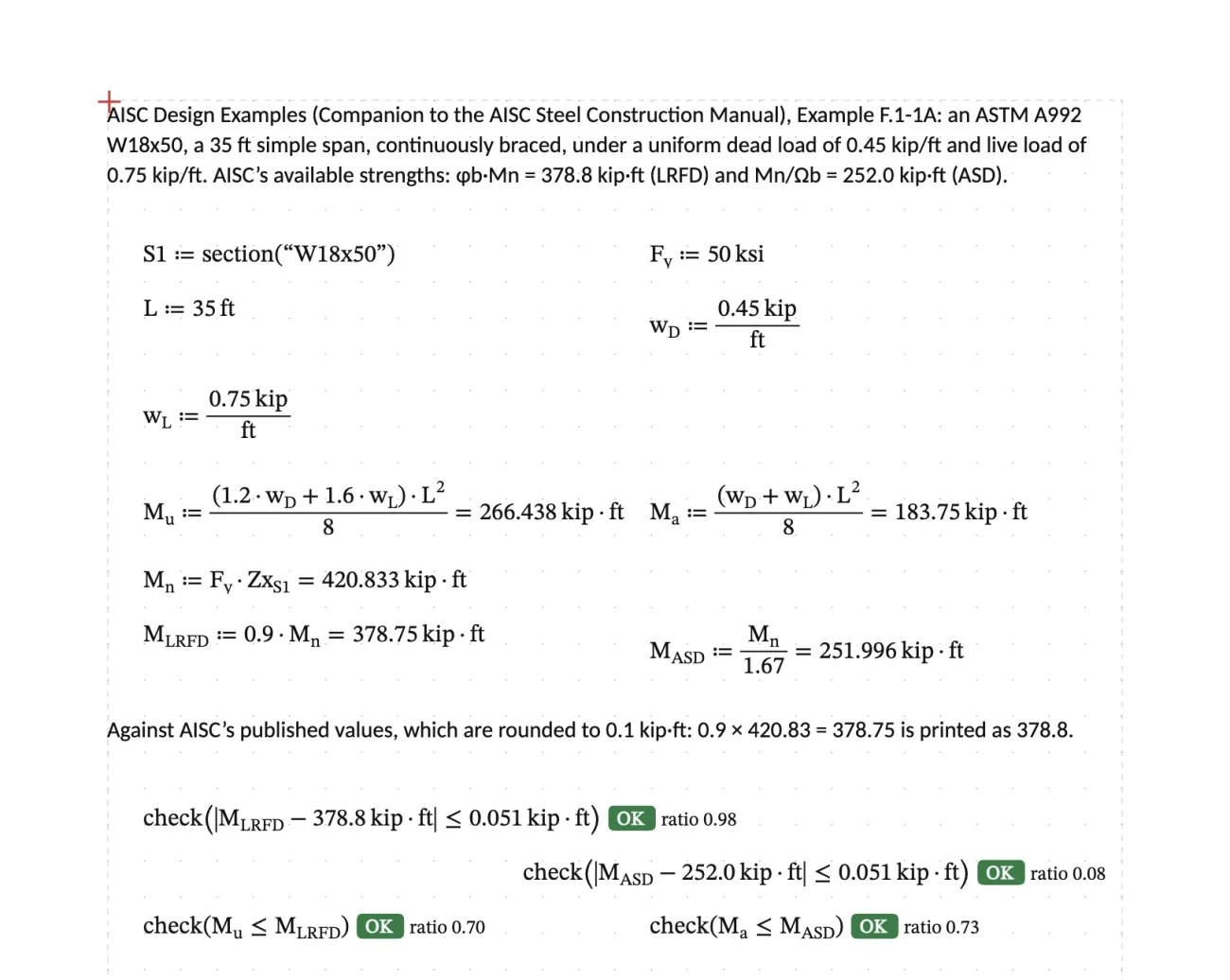
| W18x50 beam: φb·Mn = 378.8, Mn/Ωb = 252.0 kip·ft | AISC Design Examples F.1-1A | to the 0.1 kip·ft published |
| W14x132 column, 30 ft: Lc/r = 95.7, φc·Pn = 893 kips | AISC Design Examples E.1A | to the figures published |
| US customary units in SI | NIST SP 811, Appendix B | to the 7 figures published |
The NIST data is copied from the Statistical Reference Datasets by a script, never typed. Making the set found two places the engine lost figures, and both were fixed: sums, means and variances now add with compensated summation, and polynomial fits refine their answer against their residuals.
Exercises checked against Python and SymPy
32 exercises written as a textbook's are. Each states a problem, its givens vary from version to version, and its answers are left off students' copies.
Every answer of 20 versions of each exercise, 640 versions in all, is checked against a separate solution in Python. It works from the problem statement, not the worksheet, and by another method where there is one: the projectile from its acceleration integrated twice; the spring, the cantilever and the capacitor from their differential equations; the resistors by nodal analysis; the triangles from coordinates; the loan by adding up every payment's present value in exact fractions. It is exact in SymPy, or at 30 digits in mpmath, and has its own unit table, so it checks Calcwright's units too. Nearly every answer agrees to 15 figures, and the test allows a difference of 10⁻¹¹.
- The roots of a quadratic
- Two equations in two unknowns
- Radioactive decay
- A root of a cubic, numerically
- A right triangle
- Two sides and the angle between them
- Two angles and a side
- The height of a tower from two angles
- The tangent to a curve
- The area under a curve
- The largest open box
- The area between two curves
- A geometric sum
- An integral with no simple antiderivative
- Probabilities of a normal distribution
- A confidence interval for a mean
- Binomial probabilities
- A projectile on level ground
- A block sliding down a slope
- A mass on a spring
- An elastic collision
- Reactions of a simply supported beam
- The deflection of a cantilever
- A weight hung from two cables
- Resistors in series and parallel
- A capacitor charging
- A series RLC circuit
- Water on a gate
- Water through a narrowing pipe
- Heat through a two-layer wall
- A loan's monthly payment
- Saving every month
Writing them found three things in Calcwright, all fixed: derivatives are now worked by the rules on paper wherever symbolic math can, so the slope at a turning point is exactly 0; the imaginary unit is 1i, not i; and a variable named m stands in for meters in a unit after it, as in Mathcad.